Address
304 North Cardinal
St. Dorchester Center, MA 02124
Work Hours
Monday to Friday: 7AM - 7PM
Weekend: 10AM - 5PM
Address
304 North Cardinal
St. Dorchester Center, MA 02124
Work Hours
Monday to Friday: 7AM - 7PM
Weekend: 10AM - 5PM

In every construction site, precision is the key to success. A single measurement error can lead to misaligned walls, uneven flooring, or wasted materials. For decades, builders relied on manual tools like bubble levels and chalk lines — simple instruments that required skill and patience. But as modern architecture became more complex and demand for efficiency increased, a new era of measurement technology emerged: the laser level.
Since its establishment in 1997, Yangzhou WKL Opto-Electronic Instrument Co., Ltd. has been at the forefront of this transformation. By combining optical innovation with electronic intelligence, WKL has helped push the boundaries of what laser leveling tools can achieve — bringing unmatched accuracy, durability, and convenience to professionals worldwide.
This article explores the journey of laser level technology: from humble beginnings to the advanced, smart precision systems we rely on today.
Before lasers entered the scene, builders primarily used spirit levels — also known as bubble levels. These relied on a liquid-filled tube with an air bubble to determine horizontal and vertical alignment. While simple, spirit levels required constant repositioning and human estimation, which often led to minor inaccuracies over large distances.
In the late 20th century, electronic leveling devices began to appear, using sensors to improve precision. However, they were still limited by line-of-sight and lacked the projection capability needed for large-scale alignment. It wasn’t until the invention of the laser diode that true transformation began.
The first laser levels were introduced in the 1970s. These tools projected a visible laser beam onto surfaces, allowing workers to align components across long distances with ease. Early versions, however, were bulky, expensive, and often used fragile components.
As semiconductor laser technology advanced, the devices became smaller, more efficient, and more affordable. By the 1990s, laser levels had become a practical tool for both construction professionals and interior decorators.
It was during this period that companies like WKL Opto-Electronic began investing heavily in optoelectronic research, developing high-quality laser level systems tailored for the needs of builders and engineers.
One of the most important milestones in the evolution of laser levels was the introduction of self-leveling systems. Instead of requiring manual calibration, these models used pendulum or electronic sensors to automatically adjust the laser line to perfect level — even if the base surface was slightly tilted.
WKL’s modern products, such as the VS3-M5-D and VS5-3-AM, feature advanced self-leveling mechanisms with an accuracy of ±1mm/5m. This level of precision drastically reduces setup time, human error, and rework, making them indispensable for professional use.
Another major step forward was the multi-line laser system. While early models could only project a single horizontal line, today’s 3D laser levels (like WKL’s VS5-3-FQ-2) can emit three 360° planes — one horizontal and two vertical — providing complete coverage for alignment, squaring, and leveling tasks.
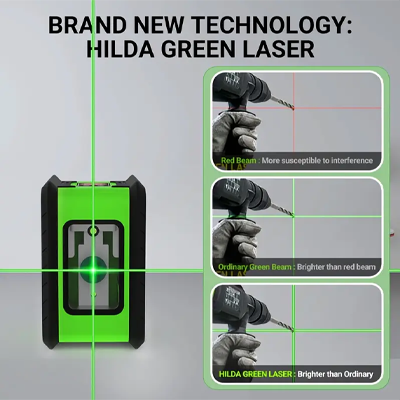
Originally, most laser levels used red laser beams, which were cost-effective and suitable for indoor work. However, visibility was limited under bright lighting conditions.
The introduction of green laser technology revolutionized the field. Green light is up to four times more visible to the human eye than red, significantly improving clarity in both indoor and outdoor environments.
WKL adopted green beam technology early on, incorporating it across its VS series for improved visibility and energy efficiency. This shift marked a major upgrade in user experience, allowing professionals to work faster and more confidently even in challenging lighting conditions.
As job sites became more demanding, so did the need for rugged and portable equipment. Manufacturers began focusing not only on precision but also on durability, compactness, and ease of use.
At WKL, every laser level is designed with industrial-grade housing, IP54 protection, and shock-resistant structures to withstand dust, vibration, and moisture. Compact bodies, magnetic mounting bases, and intuitive control panels make operation easier, even for beginners.
For example, the WKL VS3-A5(1) combines robust engineering with user-centered design — offering both portability and performance in one compact form.
Today’s laser levels are more than just tools — they’re smart instruments. With the advancement of sensors, processors, and battery technology, laser levels now feature intelligent systems for enhanced performance:
WKL integrates these smart features across its product line, allowing professionals to focus on their work instead of worrying about calibration or battery life.
The construction industry is evolving toward digitalization and automation, and laser levels play a vital role in this transformation. They are often used alongside total stations, 3D scanners, and BIM (Building Information Modeling) systems to ensure that physical layouts match digital plans with millimeter-level accuracy.
WKL’s focus on optical innovation positions the company at the intersection of traditional craftsmanship and modern precision. With continuous R&D investment and ISO9001-certified production standards, WKL ensures every product meets the needs of next-generation smart construction environments.
As technology progresses, laser levels are expected to become even more intelligent, energy-efficient, and connected. Future innovations may include:
WKL continues to explore these possibilities, driven by its commitment to innovation and customer satisfaction. The company’s design and engineering teams work closely to merge cutting-edge technology with user-centric functionality — a combination that defines the next generation of measurement tools.
From simple bubble levels to smart, 3D laser systems, the evolution of leveling tools represents a story of innovation, precision, and craftsmanship. Laser level technology has redefined how professionals build, design, and measure — improving not just accuracy, but also speed, efficiency, and confidence.
For over two decades, Yangzhou WKL Opto-Electronic Instrument Co., Ltd. has been part of this evolution. Through continuous improvement and a passion for optical engineering, WKL delivers products that reflect the future of laser technology — tools that make precision simple and perfection achievable.
Whether it’s the VS5-I, VS3-M2-A, or VS5-3-FQ-2, every WKL laser level represents more than just a tool — it’s a commitment to excellence, precision, and innovation that continues to guide the industry forward.
